
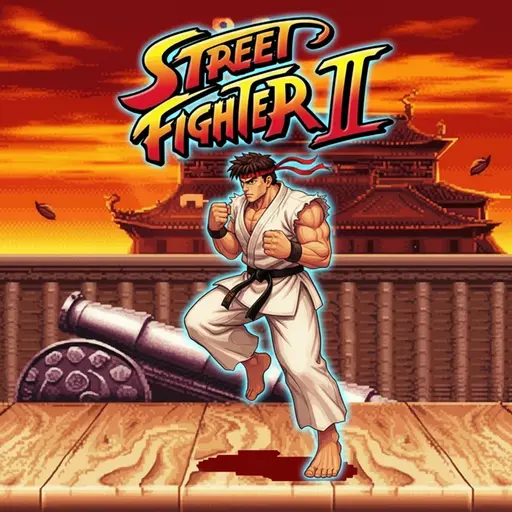
About Street Fighter 2
Capcom never developed or released an official version of Street Fighter II for the 8-bit Nintendo Entertainment System. The version running in your browser is Street Fighter 2 Pro, a notorious 1993 unlicensed port and ROM hack built from the ground up for the NES by third-party bootleg developers Cony Soft (operating under the alias Yoko Soft) and Hummer Team.
Your objective remains pure one-on-one tournament combat: pick a fighter, step into a best-of-three match, and drain your opponent’s health bar before the round timer runs out. Because this build squeezes a 6-button 16-bit arcade brawler onto a 2-button 8-bit gamepad, standard arcade muscle memory will fail you here. Quarter-circle motions and charge timings are replaced by simultaneous button combinations, sprite animations are stripped down to fit NES memory limits, and the computer AI plays by aggressive rules of its own.
The 8-Bit Conversion: How Street Fighter 2 Pro Differs from the Arcade Original
Many online guides paste move lists from the Super Nintendo or arcade releases of Street Fighter II: The World Warrior, leaving players wondering why their Hadoukens and Sonic Booms refuse to come out. Understanding the technical compromises of this 1993 pirate cartridge is the fastest way to get comfortable with its controls and pacing.
| Feature | Official Arcade / SNES Releases | Street Fighter 2 Pro (1993 NES Port) |
|---|---|---|
| Developer / Publisher | Capcom (Official) | Cony Soft (as Yoko Soft) / Hummer Team (Unlicensed) |
| Attack Buttons | 6 Buttons (Light, Medium, Heavy Punches & Kicks) | 2 Buttons (NES A and B) |
| Special Move Inputs | Quarter-circle rolls, Z-motions, and directional charges | D-Pad direction + A + B simultaneously, or rapid button tapping |
| Playable Roster | 8 World Warriors (with 4 unplayable bosses in base World Warrior) | 8 World Warriors standard (varies from 4 to 15 across bootleg revisions) |
| Ending Sequence | Character-specific illustrated story endings | Simple credits roll (can trigger via a glitch after a 2-Player Versus match) |
Because multiple cartridge dumps and ROM hack revisions circulated in the early 1990s, audio and visual quality can vary noticeably between builds. Some revisions deliver surprisingly functional 8-bit chiptunes and readable stage backgrounds, while others exhibit heavily distorted sound effects and glitched sprite palettes.
Controls and Special Move Execution on a 2-Button Gamepad
Without six dedicated punch and kick buttons, your fighter’s normal attacks change dynamically based on your stance and movement. Pressing A or B while standing, crouching, or jumping delivers your basic pokes, sweeps, and aerial kicks.
- D-Pad Left / Right: Walk forward to close distance or hold back away from your opponent to block incoming high and mid attacks.
- D-Pad Down: Crouch to duck high projectiles; hold Down-Back to guard against low sweeps.
- D-Pad Up: Jump straight up, or angle jumps forward and backward to cross up opponents or escape corners.
- A and B Buttons: Execute basic punches and kicks.
- Close-Range Throws: Step directly against your opponent and press Left or Right on the D-Pad along with an attack button to grab and toss them through their guard.
Triggering Special Moves Without Arcade Motions
Stop rolling your thumb in quarter-circles. In Street Fighter 2 Pro, special moves are adapted to non-standard NES shortcuts. Most projectiles, rising uppercuts, and lunging attacks are triggered by holding a specific direction on the D-Pad and pressing A and B simultaneously. Multi-hit techniques—such as rapid kick flurries or hand slaps—typically rely on repeatedly tapping a single attack button.
Because specific button combinations differ across Cony Soft, Yoko Soft, and Hummer Team builds, spend the opening seconds of Round 1 testing Forward + A+B, Back + A+B, and Down + A+B. Once you identify which directional pair fires your character’s primary special attack, you can execute it instantly on reaction without buffering a motion.
The World Warrior Roster and Bootleg Revisions
The standard Street Fighter 2 Pro build features the original eight World Warriors from Capcom’s 1991 roster, each scaled down to 8-bit sprites with modified hitboxes and simplified move sets:
- Ryu & Ken: Balanced fighters built around fireballs for full-screen zoning and rising uppercuts to stuff reckless jumps.
- Chun-Li: Fast walk speed and agile jumps paired with rapid-tap kick attacks that pin opponents in blockstun.
- Guile: Freed from traditional two-second charge timers in many NES builds, allowing quicker access to his projectile and flash kick equivalents.
- Blanka: Excels at close-range pressure using electric shock tapping and horizontal rolling attacks.
- E. Honda: Heavy-hitting brawler who controls space with rapid palm strikes and forward-flying headbutts.
- Dhalsim: Uses long-reaching limbs to poke from across the stage alongside flame attacks.
- Zangief: Close-quarters grappler whose throws and spinning lariats punish anyone who stays within arm’s reach.
While this core version houses those eight fighters, the wider ecosystem of unlicensed NES Street Fighter II cartridges varies wildly. Depending on the specific hack, rosters range from stripped-down 4-character carts (featuring only Ryu, Chun-Li, Guile, and Zangief) up to 15-character revisions that insert playable versions of the boss characters Balrog, Sagat, and M. Bison.
Tournament Tactics: Surviving the Cony Soft AI
In Single-Player Tournament Mode, you fight sequentially through the bracket to earn points and reach the final credits. Player reports on the NES AI range from standard aggressive pressure to nearly unblockable, spam-heavy special move loops. Because the computer does not need to charge moves or input complex motions, AI opponents will frequently chain projectiles or anti-air attacks back-to-back.
Bait and Punish Recovery Windows
Jumping forward blindly is the fastest way to lose your health bar in Street Fighter 2 Pro. Instead, stay grounded at mid-screen and hold Back on the D-Pad to block the AI’s initial special attack. 8-bit animations have distinct recovery pauses when a special move finishes or misses; wait for the opponent’s sprite to freeze at the end of a lunging attack, then counter immediately with your own D-Pad + A+B special or walk in for a close-range throw.
Playing the Round Timer
You win a round either by completely depleting the enemy’s health bar or by holding more remaining health when the round clock hits zero. If an AI fighter locks into a repetitive pattern at the far side of the screen, do not force an unsafe approach. Land one or two clean hits early to establish a life lead, then crouch-block and neutral-jump over incoming fireballs until time expires.
Modes, Glitches, and Browser Emulation Notes
Alongside the single-player tournament bracket, the game includes a Two-Player Versus Mode for head-to-head matches on the same keyboard or connected gamepads. One of the quirks of Cony Soft’s 1993 programming appears right at the end of a Versus bout: in certain revisions of the ROM, finishing a two-player match accidentally triggers the single-player end credits screen.
Because this is an emulated 1993 NES ROM running in your browser, there are no native in-game accounts, commercial age ratings, or internal battery saves—reloading the page resets your tournament progress unless the emulator overlay provides local savestates. While the ROM itself contains no built-in advertisements or microtransactions, the hosting web portal may display standard browser ads around the game frame. If you enjoy testing how classic arcade fighters adapt to home hardware and want to jump from 8-bit 2D spacing to 3D polygon combos, check out Tekken 3 for a completely different era of tournament combat.
Mastering the Quirks of 8-Bit Fighting History
Street Fighter 2 Pro is best approached on its own terms rather than compared frame-for-frame against Capcom’s arcade cabinet. Once you drop six-button habits, figure out your character’s two-button special shortcuts in the first round, and start punishing the AI’s recovery pauses, this scrappy 1993 bootleg reveals why it became a staple of Famicom and NES clone consoles worldwide.