
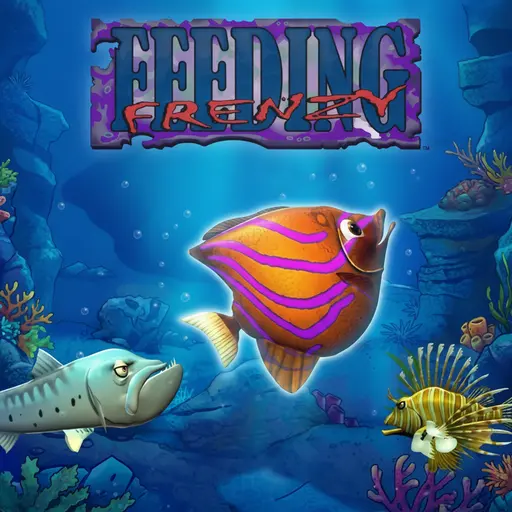
About Feeding Frenzy
Originally released on February 11, 2004, by Sprout Games and published by PopCap Games and GameHouse, Feeding Frenzy defined the aquatic eat-and-grow arcade subgenre. Its premise is simple: you begin as a small, vulnerable fish, consume smaller organisms to increase your size, dodge dangerous predators, and eventually challenge the Shark King. The edition embedded here presents that original arcade loop in a web player; platform-specific behavior should be judged from the controls and prompts shown by the loaded build.
What Is Feeding Frenzy?
Feeding Frenzy is an arcade action title centered on predatory progression and spatial awareness. You control a sequence of marine creatures across enclosed levels, each populated by a hierarchy of sea life. Fish smaller than you are food, while those larger than you are threats. As you consume prey, your growth meter fills, causing your character to enlarge. This growth often inverts the local power dynamic, turning once-deadly predators into viable food sources.
This “eat-to-grow” loop creates a rhythmic tension. Early stages require careful navigation around mid-sized carnivores, while later segments allow you to dominate the reef. For a historical look at the game’s influence on the casual action genre, visit the Feeding Frenzy Wikipedia page.
How movement works
Feeding Frenzy was designed around direct pointer movement: guide the fish toward smaller prey and away from anything large enough to eat it. The embedded player may display its own input prompt while loading, and that prompt is the reliable reference for the active build. This page does not assign unverified keyboard, touch, dash or suction controls.
Movement should be deliberate rather than fast. Sweep through a group of safe prey, then return to open water before a larger fish crosses the same area. As your fish grows, re-check which species are now edible; size changes the food chain during the level.
Character Evolution: From Angel Fish to Orca
Progression is tied to five distinct species, each with unique handling and size profiles. As you move through the levels, your character changes to reflect your climb up the food chain.
| Character | Species | Key Role |
|---|---|---|
| Andy | Angel Fish | Starter fish; high agility for dodging in tight reef spaces. |
| Leon | Lion Fish | Wider profile; balances increased eating capacity with handling caution. |
| Eddie | Angler Fish | Deep-sea specialist; utilizes a lure for low-light survival. |
| J.D. | John Dory | Heavyweight hunter; superior suction for clearing large schools. |
| Orville | Orca | Apex predator; massive size capable of swallowing endgame hazards. |
The Food Chain: Scoring and Multipliers
High scores are achieved by maintaining a “Frenzy” chain. Consuming prey in rapid succession builds your Frenzy Meter, which acts as a score multiplier.
- Feeding Frenzy: Chain 5+ fish to double your point value.
- Double Frenzy: Sustain the chain to triple points.
- Super Frenzy: Max out the meter for peak multipliers and enhanced suction radius.
Frenzy meters degrade if you pause your feeding. Strategic players use small, abundant prey to bridge the gaps between major school clusters, ensuring the multiplier remains active while moving across the screen.
Survival Tactics: Hazards and Apex Predators
Success requires identifying threats before they make contact. Hazards scale in complexity as you progress through the adventure.
- Predatory Fish: Larger than your current tier; avoid their direct line of sight.
- Jellyfish: Paralyze your fish on contact, leaving you vulnerable to predators.
- Naval Mines: Stationary explosives; avoid these at all costs as they cause instant life loss.
- Depth Charges: Explosives that sink vertically; navigate around their path to stay safe.
- Clams/Oysters: Contain pearls for massive bonuses, but they snap shut quickly; timing is critical for these high-risk, high-reward dives.
Pro Tip: Keep your fish in the center of the screen. Predators often spawn from the edges, giving you very little reaction time if you are hugging the border.
Game Modes
The game features three primary ways to play, each requiring different levels of aggression:
- Adventure Mode: The core campaign. Focuses on steady growth, narrative progression, and learning the habits of each evolution stage.
- Time Attack: A faster, more intense mode. You must chain-feed aggressively to earn extra time and clear the level before the clock hits zero.
- Bonus Stages: Safe, predator-free environments designed to maximize point collection through synchronized fish schools and bubble clusters.
Why the original still works
The game communicates risk visually: size determines what can be eaten, the growth meter marks progress, and the crowded edges warn where new threats can enter. That clarity makes score chasing and survival understandable without invented account, save or age claims. For another classic creature progression journey centered on upgrading stats and navigating obstacles, check out Duck Life 5: Treasure Hunt.
Frequently Asked Questions
How do you recover if your Frenzy multiplier starts flashing?
Quickly eat the nearest small prey fish—such as minnows or clownfish—rather than chasing distant schooling clusters. Even the smallest single prey resets the Frenzy countdown timer and preserves your double or triple score multiplier.
Can you safely eat fish while dodging naval mines and jellyfish?
Yes, but navigation takes precedence over feeding. Mines cause instant life loss regardless of your fish size tier, and jellyfish cause temporary paralysis that leaves you defenseless against apex predators. Clear the hazard first before pursuing nearby prey schools.
Conclusion
Feeding Frenzy stands as a timeless aquatic survival arcade game driven by an intuitive core loop: eat, grow, and climb the ocean food chain. By maintaining steady Frenzy multipliers, staying alert to perimeter predators, and mastering each marine protagonist from Andy the Angel Fish to Goliath the Great White, players can conquer every oceanic depth directly in their browser.