
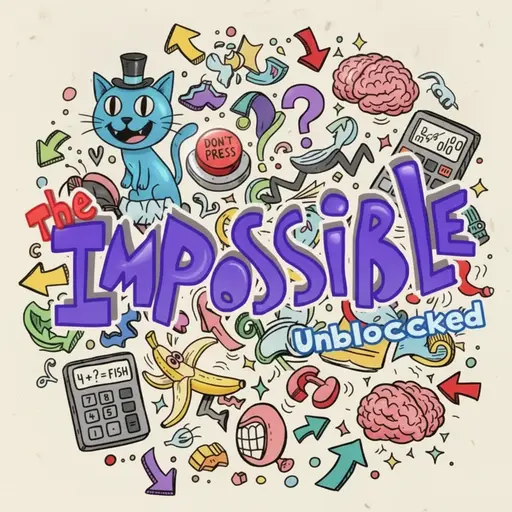
About The Impossible Quiz Unblocked
The Impossible Quiz is Splapp-me-do’s 2007 point-and-click puzzle game. It contains 110 questions, but many are visual jokes, wordplay or interface tricks rather than ordinary trivia. You begin with three lives; a wrong answer usually removes one, while certain timed bomb questions can end the run if the answer is not found quickly.
How to interact
Use the mouse to select answers and inspect anything that looks interactive. Read the entire screen before clicking: the question number, answer labels and apparently decorative objects can all matter. Some solutions require moving the pointer, clicking outside the obvious answer boxes or interpreting the wording literally.
The quiz deliberately punishes assumptions. Four visible answers do not guarantee that one of those four is the solution, and a familiar riddle may be altered by the layout. When an answer fails, remember exactly what the screen asked instead of replacing it with what you expected it to ask.
Lives, bombs and checkpoints
Three lives provide limited room for experimentation. A few questions are instant-fail obstacles, and bomb questions add a visible timer. On timed screens, scan for the unusual detail first; trying every answer in order usually wastes both time and lives.
The quiz is designed around replay and memory. Reaching a later question does not make earlier solutions random—the same observations can carry the next attempt forward. Write down a difficult answer or the reason it works if you are trying to finish the full sequence.
Use the seven skips carefully
Skips are collectable tools that let you bypass selected questions, but they are not ordinary spare lives. All seven are required at question 110. Spending one earlier can make the final question impossible even if the rest of the run is correct.
- Collect every skip you encounter.
- Do not use a skip merely to avoid learning a repeatable answer.
- Track how many remain before late-game questions.
- If a run reaches the end without all seven, restart with a collection plan rather than searching for a hidden substitute.
A better way to solve trick questions
- Read the wording aloud and look for double meanings.
- Check whether the question refers to the screen itself.
- Move the pointer carefully to reveal hover reactions without clicking.
- Test spatial ideas—position, order, color and shape—before relying on outside facts.
- After a failure, change one interpretation instead of clicking randomly.
Some answers depend on jokes or references from the game’s era. That is part of the original design, not evidence that the current browser has loaded the wrong puzzle.
Exact version note
This article describes the original-style 110-question Impossible Quiz by Splapp-me-do, not one of its sequels or a similarly named mobile quiz. The page previously sent readers to a competing portal and made unsupported security and network-access claims; those links and claims have been removed. No guarantee is made about school filters, saving, ads or third-party downloads.
The most useful preparation is a record of discovered solutions and a protected set of seven skips. For a different puzzle based on drawing a physical solution, see Car Drawing.
Different questions test different kinds of attention
The Impossible Quiz does not use one consistent definition of “answer.” Some screens are wordplay, some hide the clickable target outside the obvious choices, some ask you to remember information shown earlier, and bomb questions add a time limit. Read the entire screen—including numbers, labels and objects that do not look like buttons—before spending a life.
A conventional fact can still be the wrong response when the wording points to a literal joke or an action on the interface. On a timed screen, stop searching for a clever explanation once the required object is visible. The game alternates between patient observation and fast execution, and knowing which kind of problem is present is part of the puzzle.
Separate discovery attempts from completion attempts
With three lives, a first encounter is often best used to learn what the question reacts to. On the next run, repeat confirmed answers quickly and preserve attention for the first unsolved screen. This turns repetition into progress rather than guessing the whole quiz again.
Do not spend skips simply because a question is slow or annoying. All seven are needed at question 110, so a successful completion attempt must arrive there with the full set. A run that reveals a new answer can still be useful, but it is different from a run intended to finish the game.
Build a compact memory trail
Instead of memorizing a long list of answer letters, remember the distinctive action: the hidden object, the misleading word, the safe route through a mouse challenge, or the moment a timer begins. Action-based memory is easier to retrieve when later questions change the layout or reuse an earlier clue. It also keeps this guide useful without turning it into a screen-by-screen answer key.
Conclusion
The Impossible Quiz is an enduring masterclass in lateral thinking, visual puns, and subversive puzzle design. Surviving its 110 questions requires unlearning conventional quiz assumptions: questioning every prompt literalism, hoarding skips for timed bomb crises, and memorizing trial-and-error traps. For another brain-teasing puzzle journey focused on image deduction and word association, try 4 Pics 1 Word. If you enjoy step-by-step procedural simulations, experience the operating room challenges of Knee Surgery Simulator.